ENGINEERING TRUST / CONSTRUCTION
How a Weighbridge Is Built: Steel, Welds and Coating
Most weighbridge failures start inside the deck, where nobody can see them. This page opens the build up: the section shape, the weld strategy, the surface preparation, the paint thickness and the fatigue test.
A truck scale looks like a flat plate. In practice it is a welded box girder that spends its life being loaded off-centre, washed down, and hit by shock axles. The decisions that determine whether it lasts two years or twenty are made in the fabrication shop, long before the indicator is switched on.
We build the platform from U-section steel profiles joined into a fully welded closed cavity. The closed section gives high torsional stiffness for a given weight, and, just as important, it removes the open internal pockets where water, salt and fine aggregate collect on open-rib designs. Every seam is continuous, so there is no crevice for corrosion to start from the inside out.
Before coating, the steel is shot blasted to Sa2.5. Then a double-sided, double-layer paint system is applied and measured: dry film thickness of at least 120 um. We state the number because painted without a measured film tells a buyer nothing. The finished structure has passed a 2,000,000-cycle fatigue test carried out by a third party, which is the closest published proxy for a decade of axle loading.
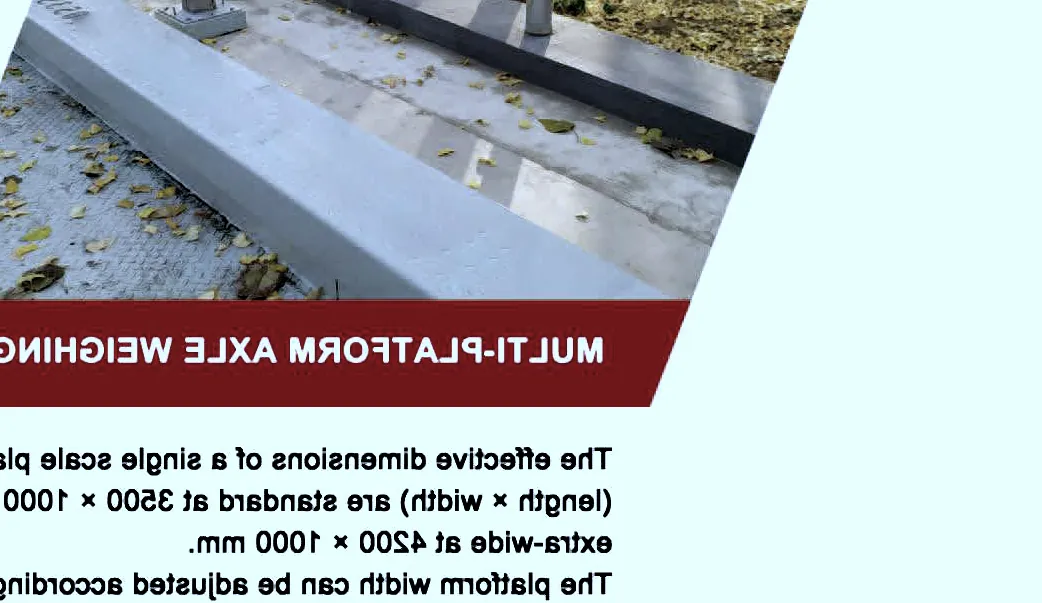
SEQUENCE / SHOP FLOOR
The build, step by step
- Profile preparation — U-section steel is cut and jigged so the closed cavity closes square.
- Continuous welding — All seams are fully welded to seal the cavity against water ingress.
- Sa2.5 shot blasting — The assembly is blasted to a defined surface cleanliness before any primer is applied.
- Double-layer coating — A double-sided, double-layer system is applied and measured at >= 120 um dry film.
- Load cell fitting — Cells are mounted and wired to the indicator with 150% overload margin.
- Fatigue validation — The standard platform is verified against a 2,000,000-cycle third-party test.
- Factory calibration — The deck is calibrated and packed with its drawing reference for installation.
DATA / MATERIALS
Construction specification
| Parameter | Value | Notes |
|---|---|---|
| Deck construction | U-section steel, fully welded closed cavity | Torsionally stiff, no open water traps |
| Standard deck | 3,500 x 1,000 mm | Width x length, nominal |
| Widened deck | 4,200 x 1,000 mm | For longer wheelbase fleets |
| Modular configuration | ZDG-type multi-platform | Matches mixed axle spacing |
| Surface preparation | Sa2.5 shot blasting | Applied before coating |
| Coating system | Double-sided, double-layer paint | Dry film >= 120 um |
| Fatigue validation | 2,000,000 cycles | Third-party test |
FIG. 01 — Plan view, modular deck, not to scale
Engineering buyers should be able to compare a weld detail and a coating thickness, not a superlative. If another supplier cannot state their dry film thickness or fatigue test count, that absence is itself a data point.
NEXT / SPECIFY
From construction to capacity
FAQ
Construction questions
How is the deck protected against corrosion?
Steel is blasted to Sa2.5, then coated with a double-sided, double-layer system measured at a dry film of at least 120 um. The fully welded closed cavity removes the internal pockets where water usually collects.
Has the structure been fatigue tested?
The standard platform has passed a 2,000,000-cycle fatigue test carried out by a third party. We publish the figure because cyclic axle loading, not a single static load, is what ends a weighbridge's life.
Can you build a non-standard deck size?
Yes. The published 3,500 x 1,000 mm and 4,200 x 1,000 mm decks are our starting points, and ZDG-type modular platforms let us match unusual axle spacing. Send the vehicle wheelbase and site footprint and we return a dimensioned proposal.
Do you provide installation guidance?
Our own installation and commissioning teams handle turnkey projects, and for distributor-led builds we supply foundation drawings, alignment tolerances, wiring diagrams and remote commissioning guidance.
How do you handle after-sales service?
Our in-house maintenance team supports calibration checks, spare load cells, indicator replacement and remote diagnostics. Distributors receive the same documentation set we use internally.
Get Spec & Quote
Send the capacity, deck, site and incoterm. An engineer reads the request and returns a documented specification with the quotation.
- Full specification table and drawing reference
- Construction and coating figures in writing
- Lead time, MOQ, payment and incoterm stated
- Static and weigh-in-motion options compared
Direct: guankai@xhlmarketing.com